

Deciding between a low-loss header and a buffer cylinder is one of those specification questions that trips up even experienced installers. Both components address hydraulic challenges in heating systems, yet they do so in fundamentally different ways — and fitting the wrong one can cause persistent problems that are frustrating to diagnose after the fact. This article sets out a clear, practical comparison to help you make the right call for your specific installation.
Any engineer who has commissioned a multi-zone heating system will have faced the question at some point: do I need a low-loss header, a buffer cylinder, or both? The terminology gets used loosely, the functions overlap in some people’s minds, and the consequences of getting it wrong only become apparent once the system is running. If you’re specifying or retrofitting a heating installation, understanding the distinction is genuinely useful — and the range of low-loss headers available from specialist suppliers like Culm Stores gives you plenty of options once you know what you need.
What is a low-loss header?
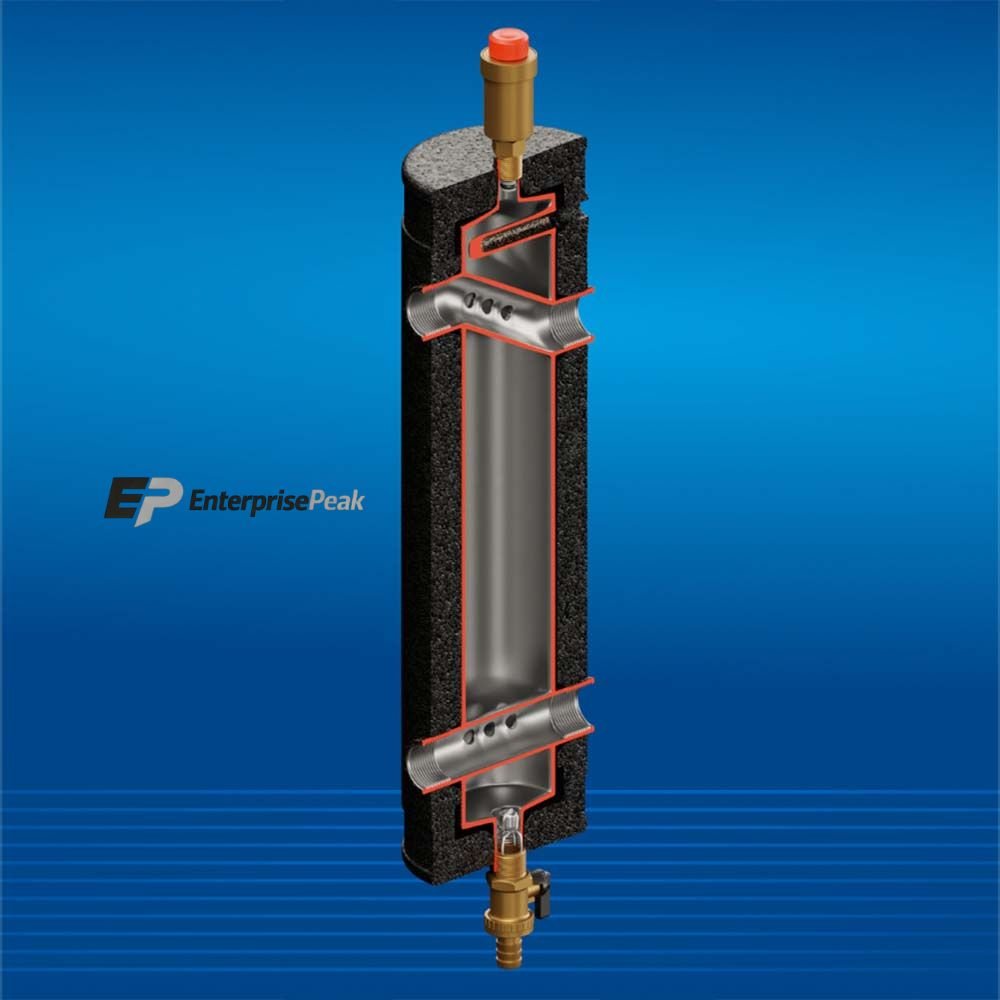
A low-loss header — sometimes called a hydraulic separator — is a relatively compact vessel that decouples the primary circuit (the boiler or heat source loop) from the secondary distribution circuits (the zones, manifolds, underfloor heating and radiator loops). It creates a calm, low-velocity zone where primary and secondary flows can exchange heat without the pumps on each side interfering with one another. The result is hydraulic separation: each circuit can run at its own flow rate and pump speed without destabilising the other.
The key word is separation, not storage. A low-loss header has minimal thermal mass and is not designed to store heat. Its job is hydraulic, not thermal.
What is a buffer cylinder?
A buffer cylinder (also called a buffer tank or thermal buffer) is a pressurised vessel designed to store a volume of hot water. Its primary function is thermal, not hydraulic. By providing a reservoir of stored heat, a buffer cylinder absorbs mismatches between heat production and heat demand — particularly useful where a boiler or heat pump has a minimum output that exceeds the immediate load. Without a buffer, the heat source short-cycles: it fires up, satisfies a small demand almost immediately, shuts down, and repeats — a pattern that causes wear, reduces efficiency and shortens component life.
Buffer cylinders are typically much larger than low-loss headers and require considerably more plant room space.
Key differences at a glance
| Feature | Low-Loss Header | Buffer Cylinder |
|---|---|---|
| Primary function | Hydraulic separation | Thermal storage |
| Size | Compact | Large (typically 50–500L+) |
| Thermal mass | Minimal | High |
| Reduces short-cycling | Indirectly | Directly |
| Multi-zone support | Yes | Limited |
| Space requirement | Low | High |
| Typical cost | Lower | Higher |
| Best for | Multi-zone, variable-speed pumps, electric boilers | Heat pumps, oversized boilers, intermittent demand |
When a low-loss header is the right choice
If your system has multiple zones with independent pumps, variable-speed circulation, or an electric boiler that responds quickly to load changes, a low-loss header is almost always the right answer. It keeps pump circuits from fighting each other, simplifies commissioning and flow balancing, and allows each zone to operate independently without affecting the primary loop. In practice, a well-specified low-loss header resolves most pump interaction and noise issues in multi-zone systems without adding significant bulk to the plant room.
Electric boilers in particular benefit from hydraulic separation. They respond rapidly to demand signals, and without a low-loss header, mismatched secondary flows can trigger unnecessary cycling reducing efficiency and stressing components over time.
When a buffer cylinder makes more sense
Buffer cylinders come into their own where the heat source has a high minimum output relative to the load — most commonly with heat pumps and some condensing gas boilers. A heat pump running below its minimum flow temperature loses efficiency rapidly; a buffer cylinder absorbs the excess output and releases it gradually, keeping the heat pump running in longer, more efficient cycles. For systems with long pipe runs, large radiators or intermittent demand (think warehouses or sports facilities), a buffer cylinder provides the thermal mass needed to smooth out peaks and troughs in demand.
When you need both
Larger commercial systems, hybrid installations combining a heat pump with an electric boiler, or buildings with both heating and cooling circuits often benefit from both components. The low-loss header handles hydraulic separation and zone decoupling; the buffer cylinder provides thermal storage and protects the heat source from short-cycling. It’s not either/or — it’s about understanding what each component contributes and specifying accordingly.
Common specification mistakes
- Fitting a buffer cylinder where a low-loss header would suffice — adding unnecessary cost and space requirements.
- Assuming a low-loss header provides thermal storage — it doesn’t, and systems with high minimum boiler outputs will still short-cycle without a buffer.
- Undersizing either component — a header that’s too small won’t provide adequate hydraulic separation; a buffer that’s too small won’t prevent cycling.
- Ignoring hydraulic separation entirely in multi-zone systems — the resulting pump interaction causes noise, uneven heating and premature pump failure.
A practical example
In a medium-sized apartment block with a central electric boiler bank and six independently controlled zones, fitting a distribution low-loss header resolved persistent pump interaction and eliminated temperature complaints from residents. The system didn’t need a buffer cylinder — the electric boilers responded well to zone demand and the header provided the separation needed for stable operation. Contrast that with a heat pump installation in a similar building: the heat pump’s minimum output required a 200-litre buffer cylinder to prevent short-cycling, with a compact low-loss header handling zone separation separately.