


Some silhouettes travel the world faster than their owners. The cowboy hat is one such object: born in the dust of the American prairies, it has made its way to Parisian catwalks and Tokyo galleries. Today, the designer cowboy hat is a precise definition of a new cultural code. It’s not a costume reference but a living language spoken by contemporary fashion.
From Prairies to Catwalks
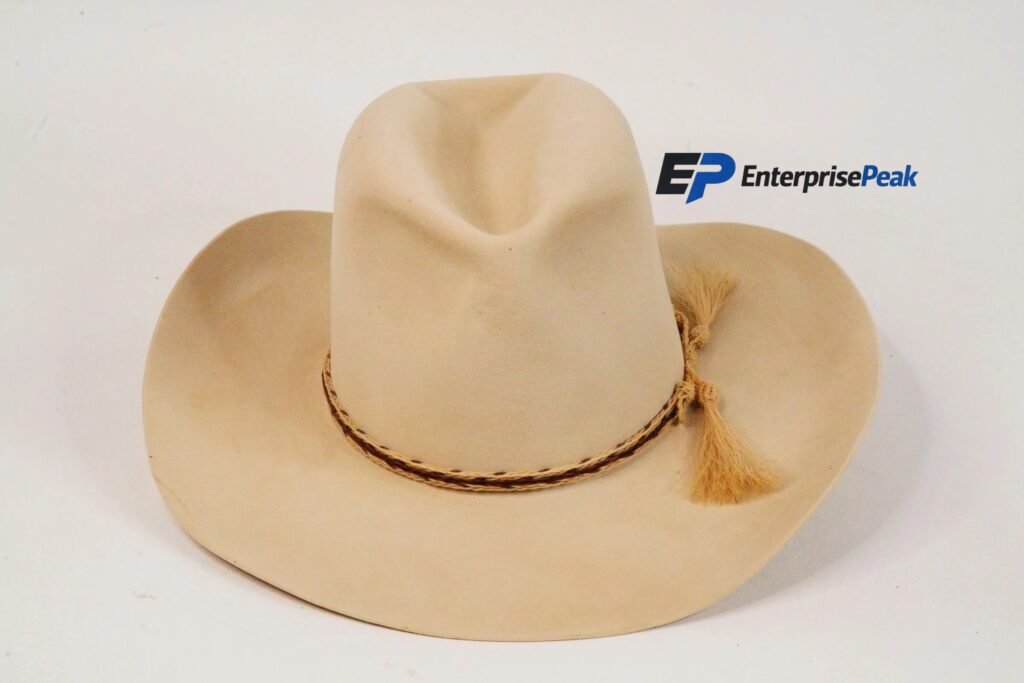
The cowboy hat’s history dates back to the 1860s, when John B. Stetson made a hat for riders in the Wild West. The wide brim protected from the sun, the high crown allowed air to circulate, and the thick felt withstood wind and rain. It was pure functionalism, without any pretensions to style.
But it was the functionality that showed the aesthetic power of the form. By the mid-20th century, Hollywood had transformed the cowboy into an archetype and the hat into a visual symbol of freedom. Then began a long journey of transformation: from a tool of the trade to a cultural icon, and from an icon to high fashion.
Translating the Classics into the Language of Luxury
Modern designers are turning to the cowboy silhouette not out of nostalgia, but for its architectural power. The wide brim and high crown create a drama lacking in many minimalist looks. In the hands of the masters at Ruslan Baginskiy, the shape takes on a new interpretation — more sculptural, precise, and subdued.
There’s no theatricality here, no direct quotes. There’s a focus on proportions, material, and fit. The felt becomes thicker, the brim more expressive, and the ribbon an instantly noticeable detail.
Why This Silhouette Works Today
The designer cowboy hat has fit seamlessly into the modern wardrobe. It’s worn with minimalist suits, evening dresses, and vintage denim. It acts as a visual anchor, instantly transforming any look into something memorable.
This headwear has become a versatile tool in the hands of those who understand fashion as a language. It’s chosen for qualities hard to find in other accessories:
- architectural expressiveness of the silhouette;
- profound cultural depth;
- versatility for daytime looks;
- drama for evening outings;
- compatibility with a variety of styles;
- recognizability without being overbearing.
Each property works in concert with the others, creating an accessory that can be both a statement and a backdrop. This is why the cowboy hat is appearing in the most unexpected contexts today.
A Cultural Code That Can Be Read Instantly
When a modern woman chooses a cowboy hat, she’s not choosing the image of a cowboy. She’s going for the confidence of the shape itself. This silhouette recalls memories of freedom, movement, and open spaces and translates them, without being too explicit, into the language of urban life.
This is the subtlety of designers’ work: preserving the spirit of the shape while freeing it from stereotypes. Today, the cowboy hat is not a masquerade but a medium through which a vast cultural history unfolds, reimagined for those who can read between the lines.
Conclusion
The cowboy hat’s journey from the prairies to the catwalk is a small illustration of how fashion works with time. It takes utilitarian objects and transforms them into carriers of meaning while preserving their structural integrity. A designer cowboy hat doesn’t try to be something it isn’t. It simply reveals new layers in a classic silhouette.