

Most people assume window cleaning is window cleaning. You get some soapy water, a squeegee, and you get on with it. But spend five minutes talking to someone who does this for a living and you quickly realise the two worlds — residential and commercial — are genuinely different jobs. Different equipment, different risks, different scheduling, different expectations. Understanding those differences helps you know exactly what you’re hiring, and why the price is what it is.
It Starts With the Building Itself
The most obvious difference is scale, but scale is only part of it.
A residential property — a terraced house, a semi, a detached home — typically has windows on two floors, maybe three. They’re accessible from the ground or a short ladder. The glass is standard double-glazing, the frames are uPVC or timber, and the job can usually be completed in under an hour.
A commercial property is a different proposition entirely. An office block in Norwich city centre, a retail unit on a busy high street, a warehouse on an industrial estate — each brings its own set of physical challenges. You might be dealing with floor-to-ceiling glazing, curtain wall systems, skylights, or glass that starts forty feet off the ground and keeps going.
The building itself dictates the method. And the method dictates the cost, the time, and the equipment required.
Access: The Defining Challenge in Commercial Cleaning
Ask any professional window cleaner like Simply Cleaning Services what separates commercial work from residential and access comes up almost immediately.
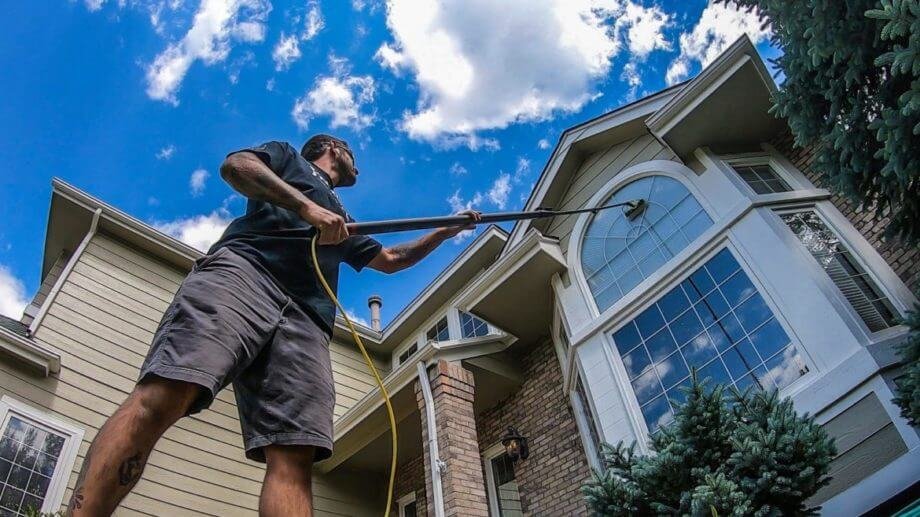
For residential properties, a water-fed pole system handles the vast majority of jobs. Water is purified, fed up through an extendable pole, and applied through a brush head that scrubs the glass before a final rinse. Most two-storey homes are well within reach. Even a three-storey Victorian terrace is manageable with the right pole length.
Commercial properties introduce access challenges that require entirely different solutions:
- Cherry pickers and mobile elevated work platforms (MEWPs) — used for buildings where height or obstruction makes pole work impractical
- Rope access — trained operatives abseil down the face of a building, typically used on high-rise structures where platforms can’t easily reach
- Cradle systems — suspended platforms that travel vertically along the face of large commercial buildings, common on modern office blocks
- Reach and wash systems on larger vehicles — extended pole systems mounted on vans or trucks, capable of reaching higher than a manually-held pole
Each of these methods requires specific training, certification, and in many cases, insurance cover that goes well beyond a standard domestic window cleaning policy. A residential cleaner with a good pole and a pure water system is not equipped — legally or practically — to work at height on a commercial building without the correct qualifications.
Frequency and Scheduling Look Completely Different
When does your window cleaner come to your home? Probably every four to six weeks, perhaps monthly in summer. You might not even be in when they arrive. It’s low disruption, quietly recurring, and easy to arrange.
Commercial window cleaning operates on a completely different logic.
Businesses have reputations to maintain. A letting agency with grimy front windows, a restaurant where diners can’t see out clearly, a car showroom where the glass looks dull — these aren’t just aesthetic problems. They affect customer perception, footfall, and in some sectors, regulatory compliance.
Some commercial clients require cleaning every week. Others opt for monthly or quarterly visits, depending on the type of premises and how much exposure the glass has to traffic, pollution, or public contact. A ground-floor retail unit on a busy pedestrianised street will accumulate grime far faster than a first-floor office above it.
Scheduling also has to work around business operations. A residential cleaner can turn up on a Tuesday morning without much fuss. A commercial cleaner working on a busy retail unit might need to arrive before the shop opens, or on a Sunday when footfall is lower. Large contracts often involve detailed scheduling agreements, site inductions, and coordination with facilities managers.
Health and Safety: A Much Higher Bar
This is the area where the differences become most significant — and where cutting corners causes real harm.
Residential window cleaning carries risk. Working at height always does. But the regulatory framework for commercial work is considerably more demanding.
The Work at Height Regulations 2005 apply to both sectors, but their practical implications are far more complex in commercial environments. Operatives working on commercial buildings must demonstrate:
- Competency in the specific access method being used
- Completion of relevant training — IPAF certification for MEWPs, IRATA qualification for rope access
- Regular equipment inspection and maintenance records
- Full risk assessments for each site
- Method statements submitted to the client before work begins
- Public liability insurance at the commercial level, often £5 million or above
A domestic window cleaner with a few years of experience and a water-fed pole does not automatically have any of this. That’s not a criticism — it’s simply a different job with different requirements. Hiring a residential cleaner for a commercial job without checking their credentials isn’t just a poor decision, it can expose the building owner or facilities manager to serious legal liability if something goes wrong.
The Equipment Gap
The kit used in residential cleaning is designed for efficiency on standard properties. Pure water systems, standard-length poles, a good squeegee, and quality cleaning solution cover the vast majority of domestic jobs.
Commercial cleaning equipment represents a significant step up in both cost and complexity.
A cherry picker capable of reaching a four-storey office building costs upwards of £300 per day to hire. Rope access equipment — harnesses, ropes, descenders, anchor systems — runs into thousands of pounds and requires regular inspection and certification. Cradle systems installed on large buildings are permanent fixtures that require their own maintenance schedules.
The vehicles required are different too. A residential cleaner might work from a small van with a pure water tank in the back. A commercial operator working on a large site might need a vehicle-mounted reach and wash system, a separate MEWP, and a support crew on the ground.
This equipment investment is one of the primary reasons commercial window cleaning costs more. It’s not simply charging more for the same job — it genuinely is a different job with substantially higher overheads.
What Gets Cleaned Is Different Too
Residential cleaning focuses on glass, frames, and sills. The job is largely consistent from one house to the next. uPVC frames, standard double-glazed units, perhaps a conservatory or a set of bi-fold doors.
Commercial cleaning is more varied, and often involves surfaces and systems that don’t appear in domestic work at all:
- Curtain wall glazing — large-format glass panels that form the outer skin of modern commercial buildings, requiring specialist cleaning techniques to avoid damage
- Solar control and self-cleaning glass — increasingly common in new commercial builds, these coatings require specific products and methods; the wrong cleaning solution can damage them permanently
- Signage and shopfronts — often included in a commercial clean, requiring careful handling around graphics, vinyl wraps, and illuminated elements
- Atriums and internal glazed areas — large internal glass structures that require access solutions and cleaning methods suited to enclosed environments
- Cladding and facades — some commercial contracts extend to the full building exterior, not just the glass
A residential cleaner encountering curtain wall glazing for the first time without the right training or products could cause thousands of pounds worth of damage. The glass itself on high-specification commercial buildings is not cheap to replace.

The Contract Relationship Is Fundamentally Different
Hiring a window cleaner for your home is usually an informal arrangement. You agree a price, they come regularly, you pay them — often in cash — and everyone is happy. If they’re ill, they rearrange. If you’re away, they might skip a visit. It works on mutual trust and flexibility.
Commercial window cleaning is typically governed by a formal service contract. That contract will specify:
- Frequency and scope of the clean
- Standards the work must meet
- Insurance requirements
- Notice periods for cancellation
- Liability provisions if damage occurs
- Health and safety documentation requirements
Larger commercial clients — supermarkets, office parks, hotel chains — often put contracts out to tender, requiring window cleaning companies to submit formal proposals with pricing, methodology, and evidence of qualifications. It’s procurement, not a quick phone call.
This formality exists for good reason. When glazing runs across an entire building facade and a cradle operative is working forty metres above street level, you need more than a handshake agreement to manage the risk.
Does the Distinction Matter to You?
If you own a home, probably not directly. Your residential cleaner almost certainly has everything they need to do the job properly, and the informal relationship works well for most people.
But if you manage a commercial property — whether that’s a small retail unit or a multi-storey office block — the distinction matters enormously. Choosing a window cleaning company based purely on price, without checking their access qualifications, insurance level, and experience with commercial glazing, is a false economy.
The right company for a residential job and the right company for a commercial job are not automatically the same company. Some operate successfully in both markets, with separate teams and equipment for each. Others specialise in one or the other.
Knowing which type of job you have is the starting point for finding the right cleaner. And now that you understand what actually separates the two, you’re in a much better position to make that call.