
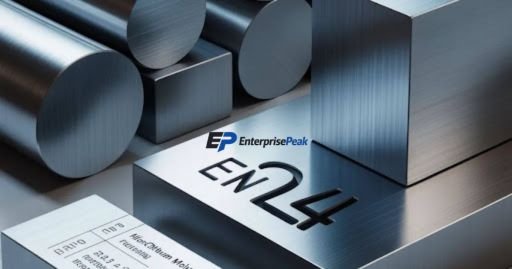

EN24 alloy steel (817M40T / EN24T) is a high-strength engineering steel known for its toughness and wear resistance, with industrial applications in UK engineering.
EN24 alloy steel (EN24T or 817M40T) is a high-strength nickel-chromium-molybdenum engineering steel used in mechanical and structural applications. The term alloy steel EN24 is synonymous with exceptional toughness, high strength and outstanding fatigue resistance, ideal for challenging engineering applications.
EN24 (817M40T / EN24T) is delivered in a heat-treated and tempered state for greater stability in mechanical properties and better machinability. This makes EN24 alloy steel a good material for parts that experience high loads, constant stress and friction.
EN24 alloy steel is also known as 817M40 and 817M40T, all of which are widely used in British Steel standards and specifications across industry and engineering.
What is EN24 (817M40T / EN24T) Steel?
EN24 alloy steel is a high-tensile, through-hardening engineering steel used for applications requiring a high combination of toughness and strength. It is being used in various industries where mechanical reliability is crucial under extreme conditions.
EN24T is a tempered form of EN24, supplied pre-heat-treated. This ensures:
- High strength consistency
- Improved machinability
- Reduced internal stresses
- Better dimensional stability
The above properties make EN24 alloy steel popular in the automotive, aerospace, and heavy engineering industry sectors.
Chemical Composition of EN24 Alloy Steel
The chemical composition directly affects the performance of EN24 alloy steel. Alloying elements give the alloy strength, hardness, and wear resistance.
Typical composition includes:
- Carbon (C): 0.36 – 0.44%
- Manganese (Mn): 0.45 – 0.70%
- Silicon (Si): 0.10 – 0.35%
- Chromium (Cr): 1.00 – 1.40%
- Nickel (Ni): 1.30 – 1.70%
- Molybdenum (Mo): 0.20 – 0.35%
- Phosphorus (P): ≤ 0.035%
- Sulphur (S): ≤ 0.040%
The key elements that affect the performance of EN24 alloy steel are very important. Nickel and chromium are added to increase the material’s toughness and impact resistance, molybdenum to enhance high-temperature strength, and carbon to improve hardness and tensile strength. All these properties make EN24 alloy steel ideal for engineering use.
Mechanical Properties of EN24 Alloy Steel
EN24 alloy steel has outstanding mechanical properties, particularly as the tempered (T) grade.
Key properties include:
- Tensile Strength: 850 – 1000 N/mm²
- Yield Strength: High resistance to deformation
- Hardness: 248 – 302 HB
- Good ductility and elongation
- Excellent impact and fatigue resistance
The mechanical properties of EN24 alloy steel make it suitable for parts subjected to repeated stresses and high loads.
EN24 vs EN24T – Key Difference
One of the major factors to consider in engineering applications is the difference between EN24 and EN24T alloy steels.
EN24 is untreated and needs to be heat-treated for use, and is not fully stabilised mechanically. It is mainly used for further processing in manufacturing industries.
EN24T, however, is supplied in a hardened and tempered condition. It can be used directly in engineering, offers good processing performance, and exhibits stable mechanical properties. These features make EN24T the most commonly used in the industry.
Key Features of EN24 Alloy Steel
EN24 alloy steel is preferred in industrial use because of its excellent engineering properties:
- High tensile strength and toughness
- Excellent wear resistance
- Good fatigue strength under repeated loading
- Suitable for heavy-duty components
- Can be further surface hardened
- Reliable performance in demanding environments
The above characteristics make EN24 alloy steel an engineering material suitable for a variety of applications.
Applications of EN24 Alloy Steel
EN24 alloy steel is commonly used in various industries where strength and durability are crucial.
Common Applications
- Gears and shafts
- Crankshafts and connecting rods
- Heavy-duty bolts and studs
- Automotive transmission components
- Hydraulic machinery parts
- Industrial machine components
- Structural engineering applications
EN24 alloy steel is particularly effective for parts that are subject to continuous mechanical stress, torsion and vibration.
Advantages of EN24 Alloy Steel
EN24 alloy steel has been designed to provide a number of engineering advantages:
1. High Strength Capacity
Has a good load-bearing capacity.
2. Excellent Toughness
Impact and load resistant.
3. Good Wear Resistance
Appropriate for a high-friction application.
4. Heat Treatment Capability
Is able to respond effectively to strengthening processes.
5. Wide Industrial Use
Applied in the automotive, aerospace and mechanical engineering industries.
Limitations of EN24 Alloy Steel
Although EN24 alloy steels have several benefits, they also have several drawbacks. It is not very corrosion-resistant and may need protection in severe or wet conditions. It is also more costly than mild steel and some uses may call for further heat treatment to achieve the desired properties.
But these are usually accounted for in engineering use because of their high strength and durability.
Equivalent Grades of EN24 Alloy Steel
EN24 alloy steel is known to the world and there are a few equivalent grades in use in various parts of the world. These include AISI 4340 (USA standard), 817M40 / 817M40T (British standard), 1.6582 (European classification) and 34CrNiMo6, which is another popular alternative.
The equivalents indicate its conformance to international engineering standards and applications.
Conclusion
EN24 alloy steel (EN24T / 817M40T) is a high-quality engineering material that is commonly used in heavy-duty industrial applications. The alloy’s nickel-chromium-molybdenum composition ensures exceptional strength, toughness and wear resistance, which is suitable for critical mechanical parts.