
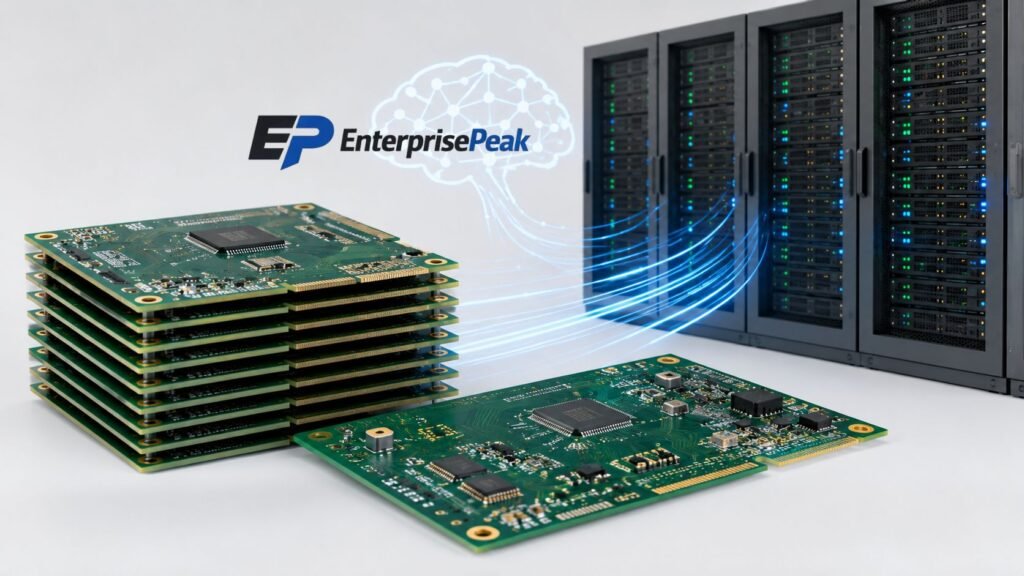

Artificial intelligence is reshaping the global technology landscape, and nowhere is that transformation more visible than in modern data centers. As organizations deploy increasingly sophisticated AI models, the demand for computing power, data processing, and storage capacity continues to grow at an unprecedented pace.
Behind every AI server, accelerator card, networking switch, and storage platform lies a critical component that often goes unnoticed: the printed circuit board (PCB).
While processors and GPUs frequently dominate discussions about AI infrastructure, PCB manufacturers play an equally important role in enabling the next generation of AI data centers. Their ability to develop advanced boards capable of handling high-speed data transmission, extreme power requirements, and demanding thermal conditions directly impacts the performance, reliability, and scalability of AI systems.
As AI workloads become more complex, PCB manufacturers must evolve alongside them to support the future of data center technology.
Why PCBs Are Critical to AI Infrastructure
Modern AI data centers rely on thousands of interconnected hardware systems working simultaneously. These include high-performance GPUs, CPUs, memory modules, networking devices, and storage systems, all of which depend on PCBs to distribute power and facilitate communication between components.
AI servers require significantly higher data throughput than traditional enterprise systems, placing enormous demands on PCB performance. Unlike conventional server environments, AI workloads involve massive parallel processing, continuous data movement, and intensive computational tasks. As a result, PCBs are no longer simple support structures; they have become critical performance enablers.
A poorly designed board can create bottlenecks that reduce processing efficiency, increase latency, and generate excessive heat. Conversely, advanced PCB technologies can improve signal integrity, enhance power delivery, and maximize overall system performance.
How PCB Manufacturers Can Support the Growth of AI Data Centers
- Meeting the Demand for High-Speed Data Transmission
One of the biggest challenges facing AI infrastructure is data movement.
Large language models, machine learning applications, and AI training clusters require servers to transfer enormous volumes of information between processors, memory systems, and networking equipment. Technologies such as PCIe 5.0, PCIe 6.0, NVLink, and ultra-high-speed Ethernet create transmission requirements that push traditional PCB designs to their limits.
To support these workloads, PCB manufacturers must invest in:
- Controlled impedance routing
- Low-loss materials 3283413 136
- Differential pair optimization
- Advanced stack-up engineering
- Signal integrity validation
High-speed server boards often require more than twenty layers to maintain performance and minimize crosstalk between signals. These complex multilayer structures enable AI hardware to process data at speeds that would be impossible using conventional PCB designs.
As AI infrastructure continues to expand, manufacturers capable of producing high-speed, high-frequency PCBs will become increasingly valuable partners for data center operators.
- Supporting High-Density Interconnect (HDI) Technologies
AI accelerators contain thousands of connections within a relatively small footprint.
Modern GPUs and specialized AI processors use advanced packaging technologies that require dense routing and sophisticated interconnection methods. Traditional PCB manufacturing techniques often struggle to accommodate these requirements. This is where High-Density Interconnect (HDI) technology becomes essential.
HDI boards allow manufacturers to create:
- Finer traces and spacing
- Microvias
- Blind and buried vias
- Increased routing density
- Smaller form factors
These capabilities enable AI hardware designers to maximize computational power while minimizing board size. As data centers seek to deploy more processing capability within limited rack space, HDI manufacturing will play a crucial role in future infrastructure development.
PCB manufacturers that expand their HDI capabilities will be better positioned to serve the growing AI ecosystem.
- Addressing Thermal Management Challenges
Heat has become one of the most significant obstacles to AI data center growth. Modern AI processors consume substantial amounts of power and generate extreme thermal loads. Industry analysts increasingly identify power density and cooling requirements as key constraints on future AI infrastructure expansion.
As rack densities continue to increase, PCB manufacturers must develop solutions that improve thermal performance and heat dissipation. These approaches are becoming increasingly important:
- Advanced Thermal Via Design
Thermal vias help transfer heat away from critical components and distribute it across larger areas of the board. Proper implementation can significantly improve operating temperatures and system reliability.
- Metal-Core and Hybrid PCB Materials
Traditional FR-4 substrates are often insufficient for advanced AI applications. Manufacturers are increasingly adopting metal-core boards and hybrid materials that provide superior thermal conductivity.
- Liquid Cooling Integration
Many hyperscale data centers are transitioning toward liquid cooling technologies. Some PCB manufacturers are already exploring designs that better integrate with advanced cooling systems and support higher thermal loads.
- Improving Power Delivery Efficiency
AI workloads require enormous amounts of electricity. Emerging AI systems are driving unprecedented increases in power density, forcing infrastructure providers to rethink how power is delivered throughout data centers. Researchers and industry experts increasingly view efficient power distribution as a major factor in future AI scalability.
PCB manufacturers can contribute to this by developing boards with:
- Enhanced power planes
- Reduced resistance pathways
- Improved voltage regulation support
- High-current handling capabilities
- Optimized power distribution networks
Efficient power delivery reduces energy waste, improves system stability, and helps operators manage growing electricity costs.
- Leveraging Automation and AI in PCB Manufacturing
Interestingly, artificial intelligence is not only driving demand for PCBs—it is also transforming how PCBs are manufactured.
Forward-thinking manufacturers are implementing AI-powered inspection systems, machine learning algorithms, and automated quality control processes to improve production efficiency and reduce defects.
Benefits include:
- Faster defect detection
- Higher production yields
- Improved manufacturing consistency
- Reduced waste
- Shorter lead times
These improvements are particularly important for AI infrastructure projects, where reliability requirements are extremely high and production volumes continue to grow.
Manufacturers that embrace intelligent automation can deliver the precision and scalability required by next-generation data centers.
- Collaborating Earlier with AI Hardware Designers
The relationship between PCB manufacturers and hardware developers is evolving. Rather than acting solely as production partners, many manufacturers now participate earlier in the design process, which helps to optimize both performance and manufacturability before production begins.
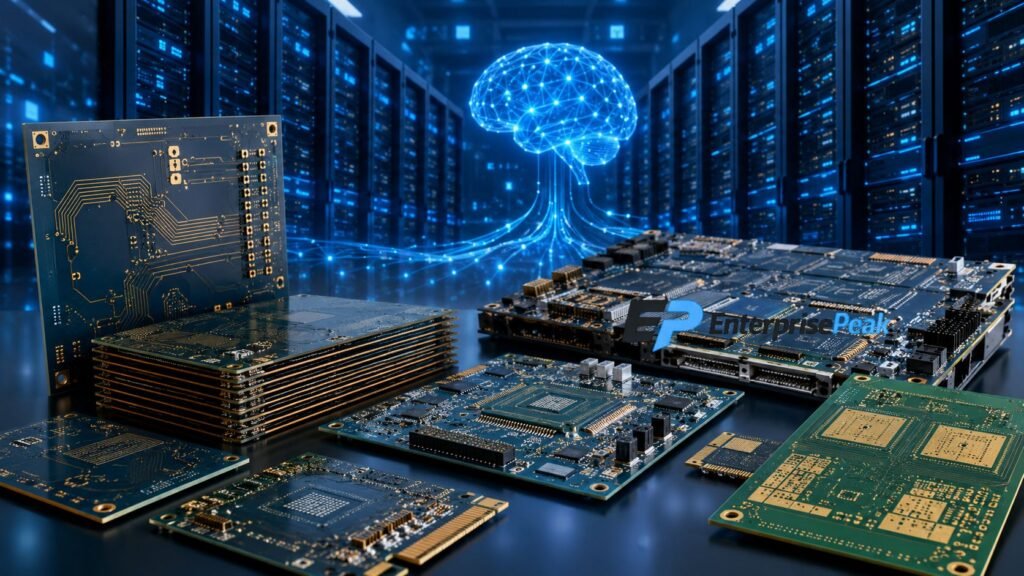
Early collaboration offers several benefits:
- Faster prototyping cycles
- Improved design-for-manufacturing outcomes
- Reduced engineering revisions
- Lower production costs
- Faster time-to-market
Given the speed at which AI technologies are advancing, reducing development timelines has become increasingly important. PCB manufacturers that provide engineering support, prototyping services, and technical consultation can create additional value for AI infrastructure developers.
- Advancing Sustainable Manufacturing Practices
The rapid expansion of AI data centers has raised concerns about energy consumption and environmental impact. As technology companies pursue sustainability goals, hardware supply chains are facing increased pressure to reduce their environmental footprint. PCB manufacturers can support these efforts by adopting greener production methods.
Examples include:
- Water recycling systems
- Lead-free manufacturing processes
- Reduced material waste
- Energy-efficient production equipment
- Sustainable substrate development
Sustainability is becoming a business priority rather than simply a compliance requirement. Manufacturers that align with environmental objectives may gain a competitive advantage as AI infrastructure investment continues to accelerate.
Conclusion: The Future of PCB Manufacturing for AI Data Centers
The growth of AI data centers will depend on much more than powerful processors and advanced software. It will require a new generation of hardware infrastructure capable of supporting faster data transmission, higher power densities, and increasingly demanding thermal requirements. PCB manufacturers sit at the center of this transformation.
By investing in high-speed PCB technologies, HDI capabilities, advanced materials, thermal management solutions, intelligent manufacturing systems, and collaborative engineering services, these manufacturers can help remove many of the hardware limitations currently facing AI infrastructure.
As artificial intelligence continues to expand across industries, PCB manufacturers will play a vital role in building the physical foundation that powers the next era of digital innovation. Their contributions may not always be visible, but they are essential to ensuring that AI data centers remain scalable, efficient, and ready for the future.