
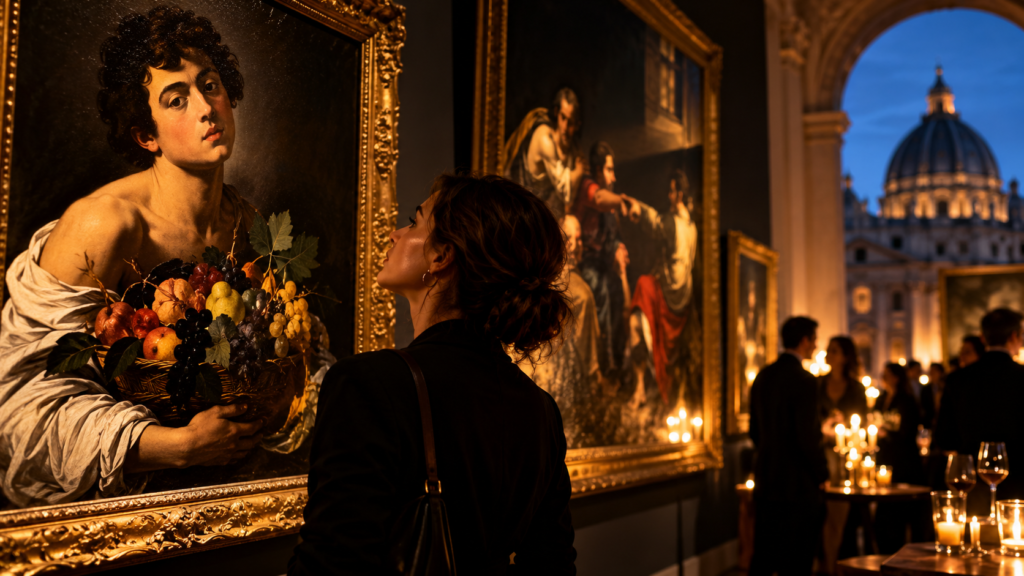

Some weekends in Rome are organised around monuments. Others work better around a mood. Caravaggio offers the perfect excuse for the second kind. His paintings belong to churches and collections across the city, but trying to see every canvas would miss much of the pleasure. A more interesting plan combines a handful of works with long lunches, evening streets, neighbourhood walks and the gradual change in Rome as daylight disappears. Caravaggio becomes a thread running through the weekend rather than its entire purpose. His art provides moments of intensity; the hours between them belong to Rome.
What makes Caravaggio a good starting point for a Roman weekend?
Caravaggio does not require visitors to spend two days inside museums. Some of his most important works remain in Roman churches, meaning an encounter with his painting can become part of an ordinary walk through the centre.
That creates a useful rhythm. Twenty minutes inside a chapel can be followed by coffee, a market, lunch or an hour wandering without a destination.
It also suits the character of his art. Caravaggio was interested in immediacy. His people occupy the foreground, gestures matter and scenes often feel as though the viewer has arrived in the middle of an event. The paintings ask for concentration, but they do not need to fill an entire day.
Begin Saturday with one painting, not an art-history lesson
The area between Piazza Navona and the Pantheon is a natural place to begin. San Luigi dei Francesi stands here, and inside it Caravaggio received one of the commissions that established his reputation in Rome.
Instead of attempting to absorb everything at once, concentrate on The Calling of Saint Matthew.
Its power depends partly on how little appears to happen. Men sit together. Another group enters. One figure points. A shaft of light gives the gesture a significance that is not immediately obvious.
Seen in person, the painting encourages patience. The eye moves between faces before understanding where the real action lies. That experience establishes a useful rule for the weekend: see fewer things, but give them enough time to become memorable.
Outside, Rome immediately provides a change of scene. Piazza Navona, the Pantheon and the smaller streets around Sant’Eustachio are all within an easy walk.
Make lunch part of the itinerary
An art weekend should not require sandwiches eaten while walking to the next museum.
Central Rome offers the chance to build the day around a proper break. After the morning visit, move away from the busiest piazzas and choose a traditional Roman lunch. The exact address matters less than allowing enough time for it.
This pause has a practical purpose. Paintings viewed continuously tend to blur together. A meal creates distance between encounters and allows the afternoon to feel like a second chapter rather than an extension of the morning.
The same principle applies to coffee. Rome rewards small rituals, and a weekend with only two days available does not become richer by eliminating all of them.
Spend the afternoon looking at Rome from above
Instead of moving directly into another gallery, change perspective.
Piazza del Popolo provides a useful destination because art and urban space meet naturally here. Santa Maria del Popolo contains important works by Caravaggio, while the nearby Pincian Hill opens onto one of the classic views across central Rome. The church itself is also notable for contributions by Raphael and Bernini, placing Caravaggio within a much broader artistic setting.
Visit the church first and then climb.
From the terrace, individual buildings begin to merge into a landscape of roofs, domes and distant landmarks. After several hours spent examining details at close range, the scale feels completely different.
Stay outside as the afternoon begins to fade. There will be enough interiors on Sunday.
Cross the Tiber before dinner
Saturday evening needs no masterpiece attached to it.
Walk towards the river and cross into Trastevere before dinner. The neighbourhood works well at this hour because its character is social rather than monumental. People gather in squares, tables occupy the pavements and streets that seemed quiet earlier become busy.
The most familiar parts can be crowded, so it is worth continuing beyond Piazza di Santa Maria in Trastevere rather than spending the entire evening around its immediate surroundings.
There is no required route. Part of the pleasure comes from letting one street lead into another and deciding where to eat only when somewhere looks inviting.
For travellers who prefer to make the neighbourhood their base, planning to discover the best hotels in Trastevere, Rome can also reduce the need to cross the city again at the end of the evening.
Give Sunday morning to a collection rather than a route
Saturday is fragmented deliberately; Sunday morning can be concentrated.
The Galleria Borghese provides the opportunity to see Caravaggio inside a collection where his work can be compared not only with other painters but with sculpture. This wider context matters.
Look closely at the fruit, fabric and skin in his earlier work. Then notice how differently later paintings use empty space and expression. The familiar idea of Caravaggio as a painter of dramatic darkness quickly becomes inadequate.
Afterwards, change medium completely and spend time with Bernini. Sculpture requires movement from the visitor: a figure changes as one walks around it. The contrast with Caravaggio makes both artists more interesting.
Once outside, Villa Borghese offers somewhere to decompress before lunch.
Choose Sunday afternoon according to energy, not ambition
By the final afternoon, there are two sensible possibilities.
Those still interested in painting can choose one collection and remain there. Palazzo Barberini offers another encounter with Caravaggio within the broader story of Italian art. Those who have reached their limit for galleries should ignore the temptation to add another one simply because time remains.
Walking is a perfectly legitimate cultural activity in Rome.
The Jewish Ghetto, the area around Teatro di Marcello and the river can fill several hours without requiring a formal itinerary. Alternatively, return towards Trastevere and continue up towards the Gianicolo for a wider view of the city.
The aim is to preserve some curiosity for the final evening rather than exhausting it by late afternoon.
Why save part of Rome for after dark?
The title “Caravaggio After Dark” should not be taken literally as an instruction to search for seventeenth-century Rome at night. That city is gone.
What darkness does offer is a change of emphasis.
During the day, Rome competes for attention. Archaeology, traffic, churches, shopfronts, fountains and crowds all occupy the same visual field. At night, much of that information disappears. Illuminated façades become isolated against darker streets. A fountain suddenly dominates a square. Restaurant windows draw attention to the people inside.
After a weekend spent looking at Caravaggio, this selective visibility feels familiar. Not because modern Rome becomes one of his paintings, but because the eye has become more conscious of what light reveals and what it leaves alone.
The paintings do not have to be the whole story
Caravaggio can easily support a specialist itinerary lasting several days. Rome preserves works connected with crucial stages of his career, including paintings in churches that remain accessible within the fabric of the city.
A weekend, however, benefits from restraint.
One memorable church in the morning, a long lunch, a hill at sunset and an evening across the river can say more about experiencing Rome than six hurried museum visits. Sunday can then provide the deeper concentration of a major collection before the schedule loosens again.
Art gives the weekend its direction without controlling every hour. Caravaggio supplies the sharp moments—the face, the gesture, the sudden illumination—while Rome supplies everything around them: conversation, food, streets, distance and darkness. Two days are enough to discover that the space between masterpieces can be just as important as the masterpieces themselves.