
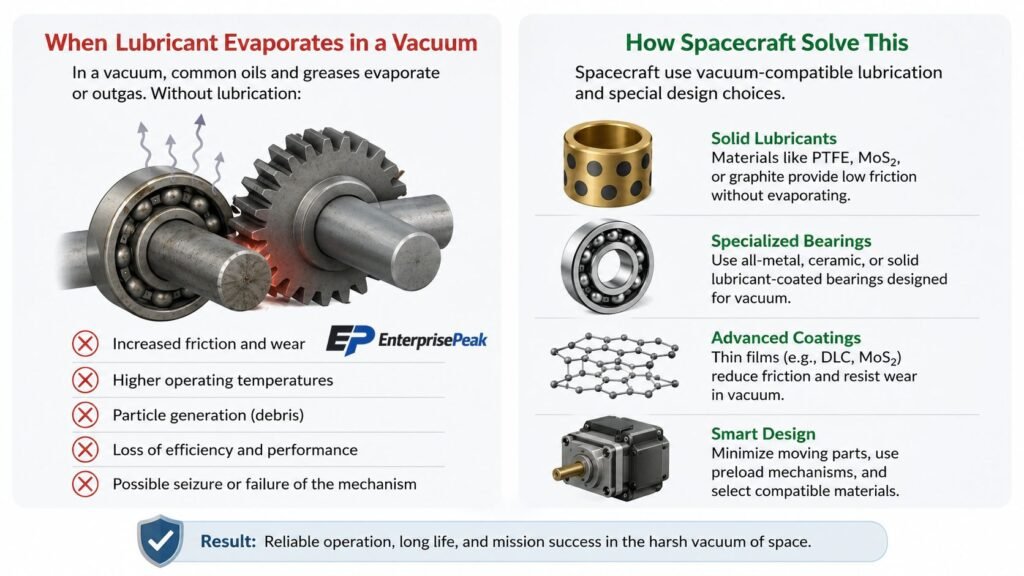

In the environment that most mechanical systems are designed for — at sea level, at temperatures between roughly -40°C and 150°C, in air — conventional fluid lubrication works well. Oil films maintain themselves between sliding surfaces, replenish during operation, and protect against the metal-to-metal contact that generates heat, wear particles, and eventually component failure. The fluid lubrication model is so effective in normal operating conditions that it has defined mechanical engineering practice for over a century.
Send the same system to space, and the oil evaporates.
This is not a metaphor. Lubricating oils and greases have vapor pressures — the pressure at which the liquid phase transitions to vapor — that are low but not zero at room temperature. In terrestrial applications, the surrounding atmosphere suppresses this evaporation: the partial pressure of oil vapor in air is overwhelmed by atmospheric pressure, and the oil stays liquid. In the vacuum of space, where pressures drop to 10⁻¹⁰ Pascal or lower, there is nothing to suppress evaporation. Lubricating oils volatilize continuously from bearing surfaces, migrating away from the contact zone and eventually contaminating optical surfaces, solar panels, or electronic components that cannot tolerate hydrocarbon contamination.
The problem is not limited to catastrophic lubrication failure — though that happens too. It is that the slow, continuous volatilization of lubricant from precision bearings, gimbals, momentum wheels, solar array drive mechanisms, and deployment hinges changes the lubrication condition of every sliding interface on a spacecraft across a multi-decade mission lifetime. A bearing that was adequately lubricated at launch may be running in a starved condition after five years, and in boundary or dry contact after ten, unless the lubrication approach was designed from the beginning for the vacuum environment.
Why conventional approaches fail and what the alternatives are.
The space industry’s response to the vacuum lubrication problem has developed along two main paths: fluid lubricants with ultra-low vapor pressures, and solid lubricants that have no vapor pressure at all.
Perfluoropolyether oils — PFPE, chemically related to the fluoropolymer family — have vapor pressures orders of magnitude lower than conventional hydrocarbon lubricants, making them suitable for space applications where a small amount of fluid lubricant is acceptable. But PFPE oils still have non-zero vapor pressure, still migrate under extreme vacuum conditions over long timescales, and introduce complexity in fluid management — ensuring that the oil reaches the bearing surfaces when needed but doesn’t migrate to contamination-sensitive areas.
Solid lubricants eliminate the vapor pressure problem entirely. A solid lubricant deposited on a bearing surface in the form of a bonded coating or transferred film has no vapor phase under any practical vacuum condition. It cannot evaporate, cannot migrate in vacuum, and cannot contaminate adjacent surfaces through outgassing. This is why solid lubricant technology has been central to space mechanism design since the earliest satellite programs.
What solid lubricants are and how they work.
The primary solid lubricant materials used in aerospace and high-vacuum applications are molybdenum disulfide and graphite — materials with layered crystalline structures that allow sheets of atoms to slide over each other with low shear resistance. In molybdenum disulfide, sulfur-molybdenum-sulfur layers are held together by strong covalent bonds within the layer but only weak van der Waals forces between layers. These interlayer bonds shear easily under contact stress, allowing adjacent crystallite layers to slide over each other while the bulk material remains in place.
This lamellar shear mechanism — lubrication through the controlled sliding of crystalline planes — does not depend on the presence of a liquid phase and is therefore unaffected by vacuum conditions. Molybdenum disulfide actually achieves lower coefficients of friction in vacuum than in air, because the oxygen and water vapor in air can oxidize the MoS₂ surface and reduce its lubricity. In vacuum, the pristine crystalline surface is exposed and performs optimally.
Everlube® 620 is a resin-bonded molybdenum disulfide coating containing graphite that offers good wear resistance and high load performance, with a continuous operating temperature range from -100° to 400° Fahrenheit.
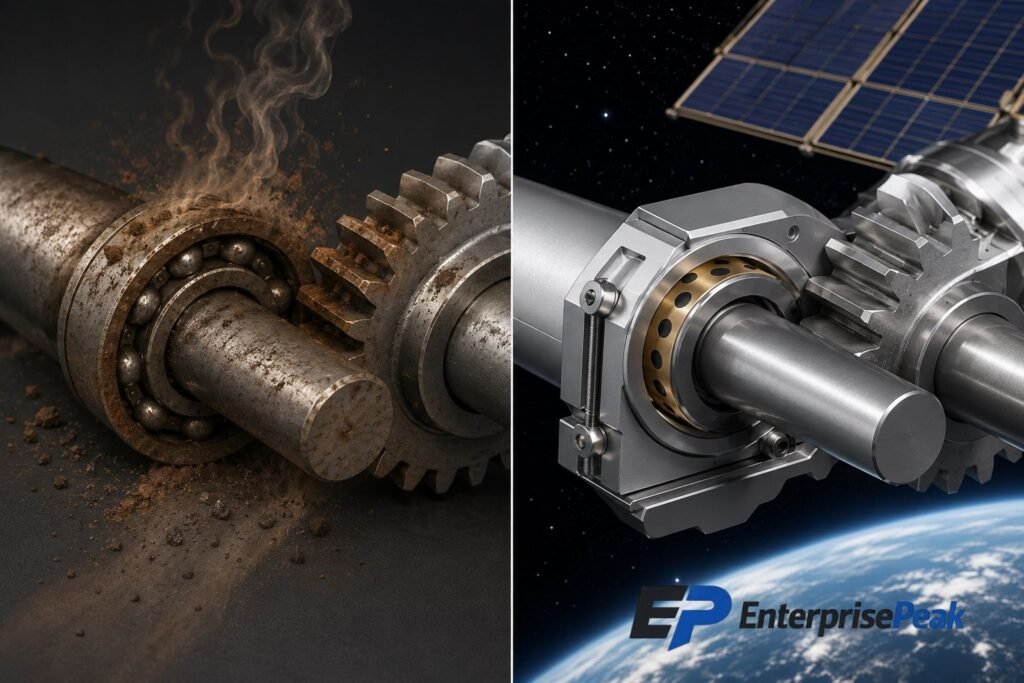
Everlube dry film lubricant coatings built around molybdenum disulfide and PTFE are used in aerospace and defense applications precisely because their performance derives from solid-phase mechanisms that function across the temperature, vacuum, and load conditions that fluid lubricants cannot handle. The same coating that keeps a fastener’s clamp load consistent in a critical aerospace assembly, or reduces the break-in wear on a gun mechanism, is applying the same material science that keeps a spacecraft’s reaction wheel bearing operational a decade after launch.
The clamp load application that bridges space and everyday engineering.
One of the most practically significant applications of dry film lubricant coatings in non-space contexts is fastener assembly. Everlube® 6102G dry film lubricant provides very good corrosion resistance and good wear resistance; for critical fastener applications, it can help minimize clamp load variability by as much as 70%. This can eliminate the need for increased torque, fastener size, or costly design changes.
The relationship between fastener surface friction and installed clamp load is not widely understood outside structural engineering, but it is consequential. When a fastener is torqued to a specified value, only a portion of that torque — typically 10 to 15 percent — actually produces the desired clamping force. The majority overcomes friction at the thread interface and under the fastener head. The variability in that friction — due to surface roughness variation, inconsistent lubrication, coating variations — produces corresponding variability in the installed clamp load, even when torque is carefully controlled.
A consistent dry film lubricant coating reduces and normalizes the friction coefficient at every fastener surface, meaning that a given torque value reliably produces a predictable clamping force with far less variability than an uncoated or inconsistently lubricated fastener. The same physics that enables a spacecraft bearing to operate reliably in vacuum is controlling the preload in a bolt that holds a flight-critical bracket in place.