
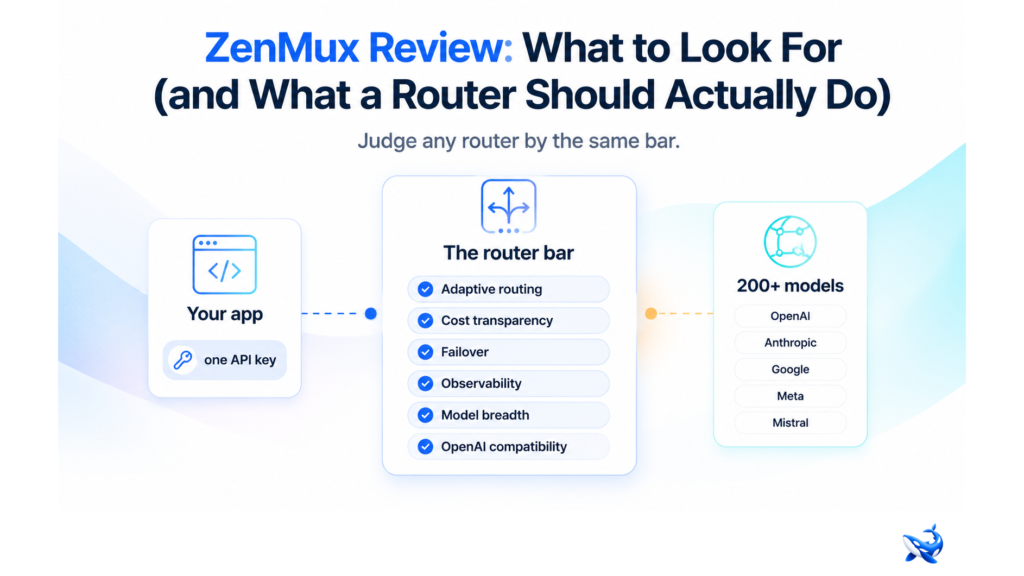

Most teams searching for a ZenMux review actually want one answer: which multi-model router is worth the integration cost? Here’s ours, up front — we’re not auditing one specific vendor’s internals today. This piece from OrcaRouter sets the bar any router should clear, then shows how we clear it. The short version: judge a router on six capabilities — adaptive routing, cost transparency, automatic failover, observability, model breadth, and OpenAI compatibility — hold every candidate, including our own, to the same checklist — the zenmux alternative post turns that checklist into a scoring rubric — and then price a real model.
There’s a reason “ZenMux review” surfaces more product pages than independent analysis: the category is young, and most of what ranks is vendor marketing or a freshly forked README. Independent teardowns of any single router are thin on the ground, because the honest ones need access to a control plane most reviewers don’t have. So we won’t pretend to audit another product’s uptime and billing from the outside. The more useful job is to publish the bar, define each capability tightly enough that you can test it in an afternoon with your own traffic, and then score OrcaRouter against that bar with facts you can check on our pages. The stakes are real: a router is infrastructure, and it becomes the single component that knows about every provider you call. Getting the choice wrong means living with a routing layer you can’t audit, on a bill you can’t reconcile — for years, because replacing a router is as painful as replacing a database.
Why this is a checklist, not a vendor teardown
A review that leans on an outsider’s screenshots of someone’s dashboard is weak evidence — you can’t verify it, and it’s stale the week it’s published. A capability bar is reproducible: it’s a list of behaviors any router must show, each defined well enough that you can run the same test and reach the same conclusion. That’s the format here. If you’re reading this, you’re likely weighing a tool like ZenMux against a shortlist that includes routers you can actually trial; the checklist below is the filter you’d apply to every name on it. Two ground rules keep the review honest. First, where a claim is ours, we say so and point at the page you can open to confirm it. Second, where a claim belongs to a competitor, we don’t repeat it — unverifiable numbers don’t belong in a review, and a review that cites a rival’s marketing as fact is advertising with a byline.
The six capabilities any router should clear
Six behaviors separate a real router from a glorified endpoint picker. Here they are, in roughly the order teams feel them. None of the six is exotic; together they’re the difference between a routing layer you trust and one you’re constantly double-checking.
Adaptive routing
Routing is the job the category is named for, and static routing isn’t enough. The bar: a router should read each request and decide which model answers it — ideally grading the prompt first. Each prompt is scored against your quality standard in under a millisecond and sent to the cheapest model that clears the bar [OrcaRouter]. Easy questions hit a fast, inexpensive model; hard ones escalate to a frontier model, and the decision holds in routing modes like orcarouter/auto so it’s consistent across every request [OrcaRouter]. Two extra checks worth running: session-aware routing, so context from a conversation influences the next choice, and prefix-aware routing, so repeated request prefixes skip straight to a sensible model [OrcaRouter]. If a router can’t explain how it picks a model, it isn’t routing — it’s picking a default. Ask the vendor to show you the decision rule in plain language; if the answer is a machine-learning shrug, walk away.
Cost transparency
Cost is where routing math usually breaks. The bar: the price you route on is the price you pay, with nothing hidden in between. Any markup — even a small one — corrupts the “cheapest model” calculation and turns every routing decision into a guess, because the router’s own incentives stop matching yours: the more it charges you over list price, the more it earns from sending you to the wrong model. OrcaRouter passes provider list prices through at 0% markup, with glass-box receipts on every request, so the number you see when you route is the number you’re billed [OrcaRouter]. Bring-your-own-key setups keep that true when you’d rather bill through your own provider account [OrcaRouter]. Test any candidate by asking for the arithmetic on a single request — model, tokens, and the provider’s published price for both — and check the cents line by line. If the vendor can’t show it, that’s the review.
Automatic failover
Providers go down, rate limits get hit, keys expire, models time out. The bar is failover that needs no human in the loop: the router re-routes the request to a healthy provider and the user never sees the failure [OrcaRouter]. A router that needs someone to flip it over at 2 a.m. is a load balancer with a pager attached, and the honest framing is that every provider will fail eventually — the question is whether it becomes an incident in your service or a line in a log. During evaluation, kill your strongest model’s key and watch whether the next request lands elsewhere on its own — that one test tells you more than any uptime page.
Observability
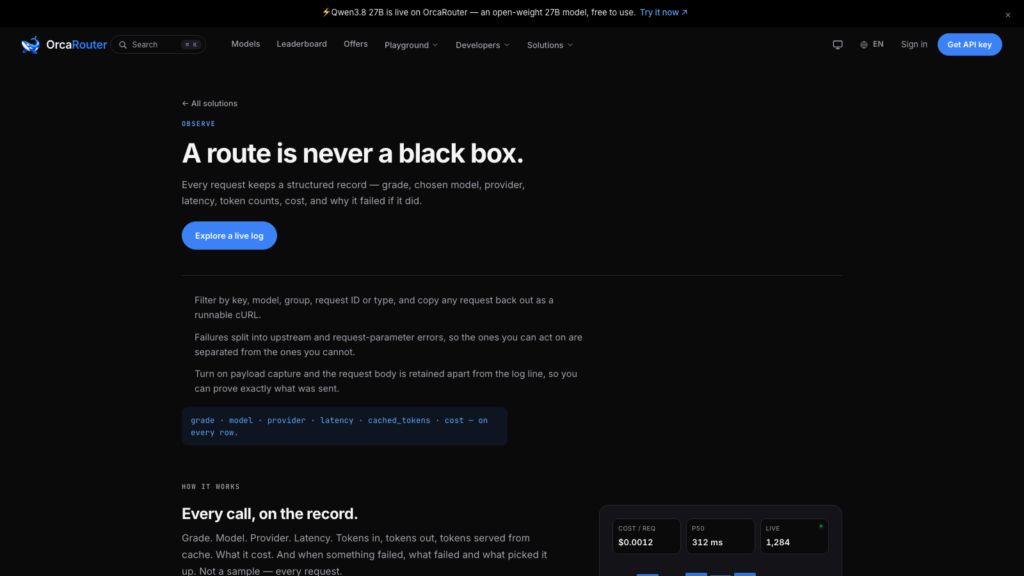
Every request should be accountable. The bar is a per-request log — which model answered, how long it took, how many tokens it used, what it cost — so “where did the budget go?” becomes a query instead of spreadsheet archaeology [OrcaRouter]. Budgets and roles are part of the same job: the router should be able to cap what a team or feature spends, not just report on it after the fact [OrcaRouter]. Ask for the request log on day one. If a vendor can’t produce one accountable line per request, every other promise about savings is unverifiable.
Model breadth
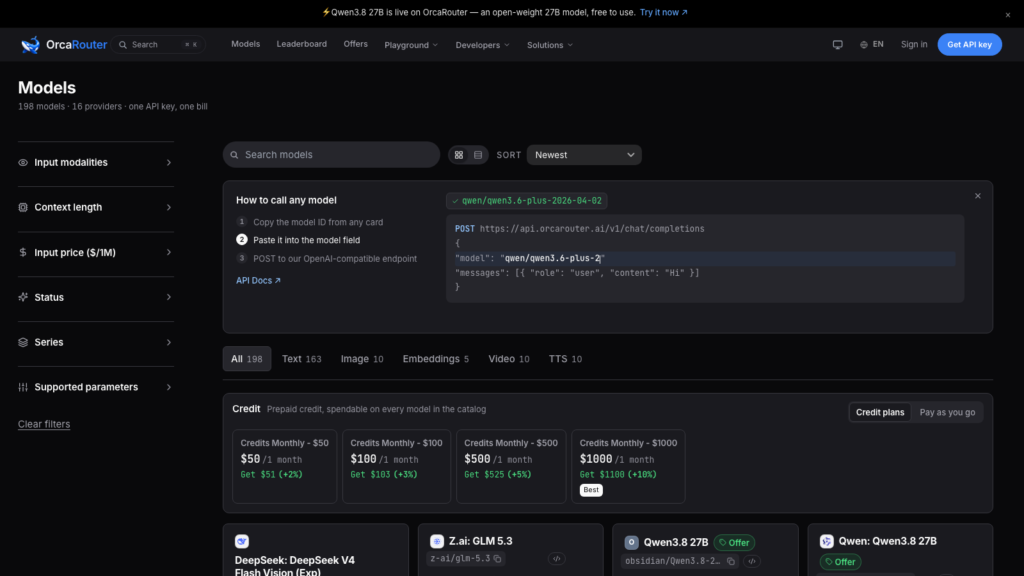
Model breadth is the reason a router exists. The bar: one API key reaching 200+ models across OpenAI, Anthropic, Google, Meta, Mistral, xAI, DeepSeek, Qwen, GLM, and MiniMax — through a single endpoint [OrcaRouter]. A router with three models is an integration; a router with real breadth is what lets you retire per-provider SDKs, contracts, and security reviews. When you evaluate, read the catalog like a menu: it should list far more than the models you know, because breadth is what makes “route to the cheapest qualifying model” a real decision rather than a coin flip. Also check that the catalog updates as providers ship — a router that lags a week behind every model release is a router that’s routing you to yesterday’s prices.
OpenAI compatibility
The compatibility bar: your existing OpenAI-shaped code should talk to the router without a rewrite [OrcaRouter]. If a router forces a proprietary client on you, the switching cost silently eats any routing savings, and you’ve also welded your codebase to a vendor you haven’t fully vetted yet. The routers that win this category are the ones that look like the thing you already call — same endpoints, same payloads — so the day you add the router is the day nothing else in your codebase changes. A drop-in endpoint is also the fastest way to run the tests in this review: if your existing client works against it, integration risk just got retired.
| Capability | The bar any router should clear | OrcaRouter |
| Adaptive routing | Grades each prompt in under 1 ms, routes to the cheapest qualifying model | orcarouter/auto mode, session- and prefix-aware [OrcaRouter] |
| Cost transparency | Routes on the price you actually pay | 0% markup; provider list prices passed through [OrcaRouter] |
| Automatic failover | Recovers without a human in the loop | Automatic failover built in [OrcaRouter] |
| Observability | One accountable line per request | Per-request request logs, budgets & roles [OrcaRouter] |
| Model breadth | A real catalog behind one key | 200+ models via one API key [OrcaRouter] |
| OpenAI compatibility | No rewrite of existing code | OpenAI-compatible endpoint [OrcaRouter] |
The takeaway
Here’s how to use this if you’re working a “ZenMux review” shortlist. Run each candidate through the six bars with your own traffic: send a batch of easy and hard prompts and watch where they land; revoke a key mid-stream and see if the next request recovers; bill one request and check the arithmetic against the provider’s own price; read one log line. Any router that clears all six is worth paying for, and any router that can’t show its work on one of them is out. We built OrcaRouter to clear this exact bar, and we’ve published the pages that let you verify it — the routing flow, the request logs, and the comparison that shows the checklist in practice. This is who the checklist is for: a team with two or more models in production, a bill it can’t explain, or a provider switch on the calendar. It’s overkill if one model and one key describe your stack — that’s fine, and it’s also the cheapest possible conclusion to reach, because you’ve just avoided infrastructure you didn’t need. Judge every candidate, including ours, by the same bar; that’s what a real review is for.
Sourcing note: Product facts — one API key for 200+ models, prompts graded in under 1ms and routed to the cheapest qualifying model, session- and prefix-aware routing, 0% markup pass-through of provider list prices, automatic failover, per-request logs, budgets & roles, BYOK, and the OpenAI-compatible endpoint — are OrcaRouter’s own published claims, checked on its homepage and product pages August 22, 2026. No ZenMux statistics are cited; ZenMux is named only as the search intent this article targets. No third-party benchmark or pricing data is used.