
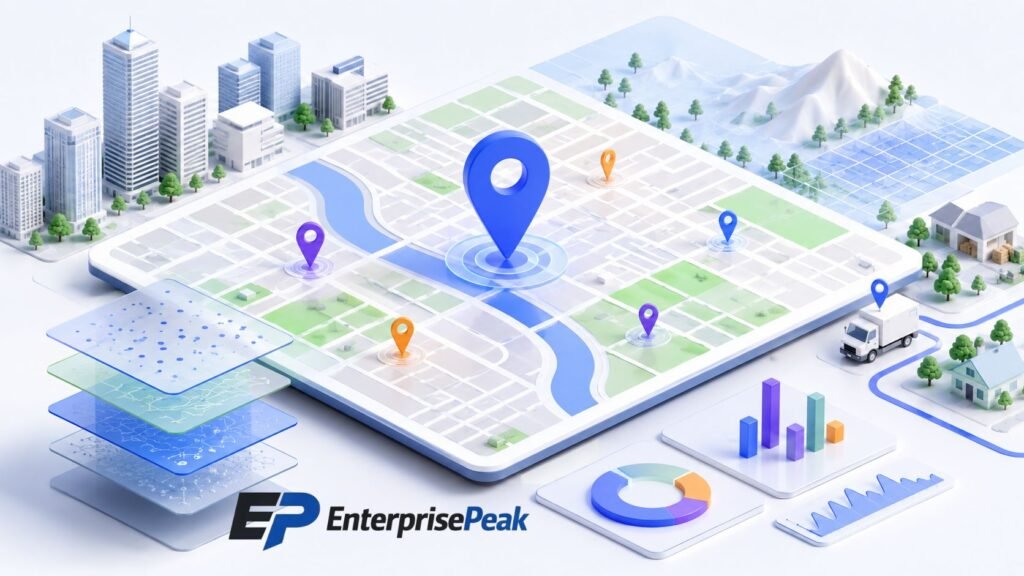

Location plays a much larger role in daily life than many people realize. From navigating traffic and finding nearby businesses to managing delivery routes and monitoring infrastructure, geographic information influences countless decisions made by individuals, companies, and governments. As digital technology has advanced, organizations have become increasingly dependent on tools that allow them to collect, analyze, and use location-based information in meaningful ways. These capabilities have given rise to a broad category of technologies commonly referred to as geographic or geospatial services.
Although many people interact with location-based applications every day without thinking about the underlying systems, geo services have become essential components of modern operations across numerous industries. Transportation companies use them to optimize routes. Utility providers rely on them to manage infrastructure. Retailers analyze location data to understand customer behavior. Emergency responders depend on mapping tools to coordinate resources quickly. The growing importance of spatial information has transformed geographic technology from a specialized discipline into a practical business tool used around the world.
Understanding Geo Services
At their core, geo services involve technologies and systems that collect, process, analyze, and present information tied to physical locations. The term encompasses a wide range of capabilities, including digital mapping, geographic information systems, satellite imagery, GPS tracking, geocoding, route planning, spatial analytics, and location-based data management.
Modern geo services allow businesses and organizations to connect information with specific geographic coordinates. Instead of viewing data as isolated numbers or records, users can understand where events occur, how locations relate to one another, and how geography influences patterns and decisions. This ability to combine data with location creates opportunities for improved planning, efficiency, and analysis.
Many people encounter these technologies through smartphone navigation apps, delivery tracking systems, or interactive maps. Behind the scenes, however, geo services involve sophisticated technologies that continuously process massive amounts of geographic information and make it accessible through digital platforms and software applications.
How Geographic Data Is Collected
The foundation of every location-based system is geographic data. This information originates from numerous sources and is constantly updated to maintain accuracy. Satellites provide imagery and positioning information that support navigation and mapping systems. Global Positioning System technology allows devices to determine precise locations by communicating with satellites orbiting the Earth.
Surveying equipment, drones, sensors, and mobile devices also contribute valuable data. Smartphones continuously generate location information when users access navigation applications or location-enabled services. Vehicles equipped with telematics systems transmit movement data that can be used to monitor fleets and optimize routes.
Government agencies maintain extensive geographic databases containing information about roads, boundaries, infrastructure, land use, and environmental features. Businesses often supplement these sources with their own operational data, customer information, and asset records.
Once collected, geographic data must be organized and processed to make it useful. This is where specialized software platforms and geographic information systems play an important role.
The Role of Geographic Information Systems
Geographic Information Systems, often referred to as GIS, serve as one of the central technologies behind modern location intelligence. These systems allow users to store, manage, analyze, and visualize geographic information through digital maps and spatial databases.
Unlike traditional spreadsheets or reports, GIS platforms provide a visual representation of data. Information can be layered onto maps to reveal patterns that may not be obvious when viewed in numerical form. For example, a utility company can display power lines, maintenance records, customer locations, and weather conditions simultaneously. This helps managers understand relationships between assets and prioritize repairs more effectively.
GIS technology also supports advanced analysis. Organizations can evaluate travel distances, identify service areas, monitor environmental conditions, and assess risks associated with specific locations. Because geographic information systems combine multiple data sources, they provide a more complete picture of operational conditions and support better decision-making.
How Location-Based Technologies Work
Many geo services rely on a combination of positioning technologies, databases, and software applications working together behind the scenes. GPS devices determine locations through satellite signals, while digital maps provide reference information such as roads, landmarks, and addresses. Geocoding processes convert street addresses into geographic coordinates that computers can interpret.
Routing algorithms analyze road networks and traffic conditions to calculate efficient travel paths. Real-time data feeds continuously update maps with information about weather, congestion, accidents, and construction activity. Mobile applications then present this information in ways that are easy for users to understand.
Cloud computing has further expanded the capabilities of location-based technologies. Rather than storing geographic data on individual computers, organizations can access centralized platforms that provide mapping tools, analytics, and collaboration features from virtually anywhere. This accessibility allows teams across multiple locations to work with the same information and respond quickly to changing conditions.
Artificial intelligence is also beginning to enhance geo services by improving pattern recognition, forecasting, and automation. Machine learning algorithms can analyze spatial data and uncover insights that would be difficult to detect manually. As these technologies continue to mature, location intelligence is becoming increasingly powerful.
Applications Across Industries
Geo services support a remarkably diverse range of industries and use cases. Transportation and logistics companies depend on location data to optimize delivery routes, monitor vehicles, and improve fuel efficiency. Real estate professionals use mapping technologies to analyze property values and evaluate market trends.
Utility companies rely on geographic systems to manage pipelines, electrical grids, and water infrastructure. Telecommunications providers use location intelligence to plan network coverage and identify service gaps. Construction firms use mapping tools to coordinate projects and monitor equipment.
Public safety organizations benefit from location-based technologies during emergency response operations. Fire departments, law enforcement agencies, and disaster management teams use maps and geographic information to allocate resources and coordinate efforts more effectively.
Retail businesses also use location intelligence to understand customer demographics, determine store locations, and evaluate market opportunities. Healthcare organizations analyze geographic patterns to improve access to medical services and monitor public health trends.
The versatility of these technologies has made them valuable assets in both private and public sectors.
Benefits of Location Intelligence
One of the greatest advantages of geo services is their ability to transform large volumes of information into actionable insights. Visualizing data through maps often reveals relationships that might otherwise remain hidden. Organizations can identify trends, optimize operations, and make more informed decisions based on geographic context.
Efficiency improvements are another major benefit. Route optimization reduces travel times and fuel consumption. Asset tracking improves resource utilization. Real-time monitoring allows organizations to respond quickly to changing conditions. These capabilities can lower costs while enhancing productivity.
Geo services also support better planning. Businesses can analyze market opportunities, assess risks, and allocate resources more strategically. Government agencies can make informed decisions regarding infrastructure development, land management, and environmental protection.
Perhaps most importantly, location intelligence enhances visibility. Understanding where assets, customers, and activities are located provides organizations with valuable perspectives that improve both short-term operations and long-term planning.
The Future of Geo Services
As technology continues to evolve, geo services are becoming increasingly sophisticated. Artificial intelligence, cloud computing, drones, connected devices, and real-time analytics are expanding the possibilities of location-based solutions. Digital twins, autonomous vehicles, smart cities, and advanced environmental monitoring systems all rely heavily on geographic intelligence.
The growing availability of data and improvements in processing capabilities are enabling organizations to gain deeper insights from spatial information than ever before. Businesses that once viewed mapping as a simple navigation tool now recognize it as a strategic resource that supports decision-making across numerous functions.
Geo services represent far more than digital maps. They provide a framework for understanding how geography influences people, infrastructure, resources, and operations. By connecting information to physical locations, these technologies help organizations improve efficiency, enhance planning, and uncover valuable insights. As location intelligence continues to evolve, geo services will likely play an even greater role in shaping how industries operate and how people interact with the world around them.