

The networking industry is moving quickly toward 400G and 800G technologies, especially in AI-driven data centers. As a result, it is easy to assume that 100G optics are becoming obsolete. In reality, 100G remains one of the most widely deployed speeds for data center interconnect (DCI) applications, and 100G ER4 modules continue to play an important role in connecting facilities across metropolitan areas.
The Ongoing Demand for 100G DCI
Data center interconnection has become a critical part of modern network design. Organizations increasingly operate multiple facilities to support disaster recovery, business continuity, workload distribution, and cloud integration.
While hyperscale operators are investing in 400G and beyond, many enterprise networks still rely heavily on 100G infrastructure. Existing switches, routers, and transport equipment are already designed around 100G interfaces, making it a practical and cost-effective choice for many deployments.
In addition, not every application requires hundreds of gigabits of bandwidth. Many inter-data-center links primarily handle data replication, backup traffic, virtual machine migration, and enterprise applications. For these workloads, 100G often provides more than enough capacity while keeping network costs under control.
Meeting the Need for Longer Distances
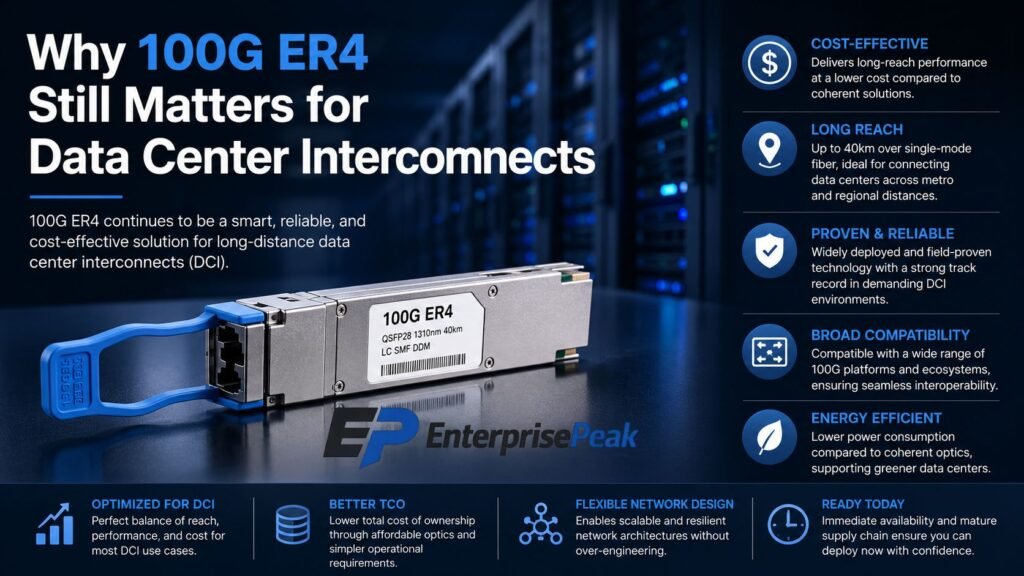
One of the biggest advantages of 100G ER4 is its ability to support transmission distances of up to 40 kilometers over single-mode fiber.
This makes ER4 particularly suitable for connecting data centers located in different parts of a city or across a metropolitan region. In many real-world deployments, facilities are separated by distances that exceed the capabilities of 100G LR4 modules but do not justify the complexity of coherent optical solutions.
Typical use cases include:
Primary and disaster recovery data centers
Campus-to-campus connectivity
Enterprise metro networks
Edge data center aggregation
Regional cloud infrastructure
For these applications, 100G ER4 provides a straightforward way to extend Ethernet services without introducing additional transport layers.
A Practical Alternative to ZR Solutions
When network planners evaluate long-distance connectivity, 100G ZR optics often enter the discussion. While ZR modules can support significantly longer reaches, they are not always the most economical choice.
Many DCI links fall within the 10 km to 40 km range, where ER4 optics are fully capable of meeting transmission requirements. Deploying ZR modules in these scenarios can increase hardware costs without delivering meaningful operational benefits.
ER4 modules generally offer a simpler deployment model as well. They can be integrated directly into Ethernet switches and routers, reducing the need for additional equipment and minimizing network complexity.
For organizations focused on balancing performance and budget, ER4 often represents the most practical solution.
Supporting Enterprise and Metro Networks
Beyond traditional data centers, 100G ER4 modules are widely used in metropolitan-area networks. Service providers frequently deploy them to connect central offices, aggregation sites, and customer facilities across urban environments.
Enterprises are also adopting distributed IT architectures, where applications and storage resources are spread across multiple locations. As these environments grow, dependable 100G links become essential for maintaining service continuity and application performance.
Because ER4 modules use standardized Ethernet interfaces, they fit naturally into both enterprise and carrier networks without requiring significant architectural changes.
Conclusion
Despite the industry’s focus on higher-speed technologies, 100G ER4 remains highly relevant for data center interconnect applications. It provides the reach needed for metropolitan deployments, supports a wide range of enterprise and service provider use cases, and offers a cost-effective alternative to more complex long-haul solutions.