
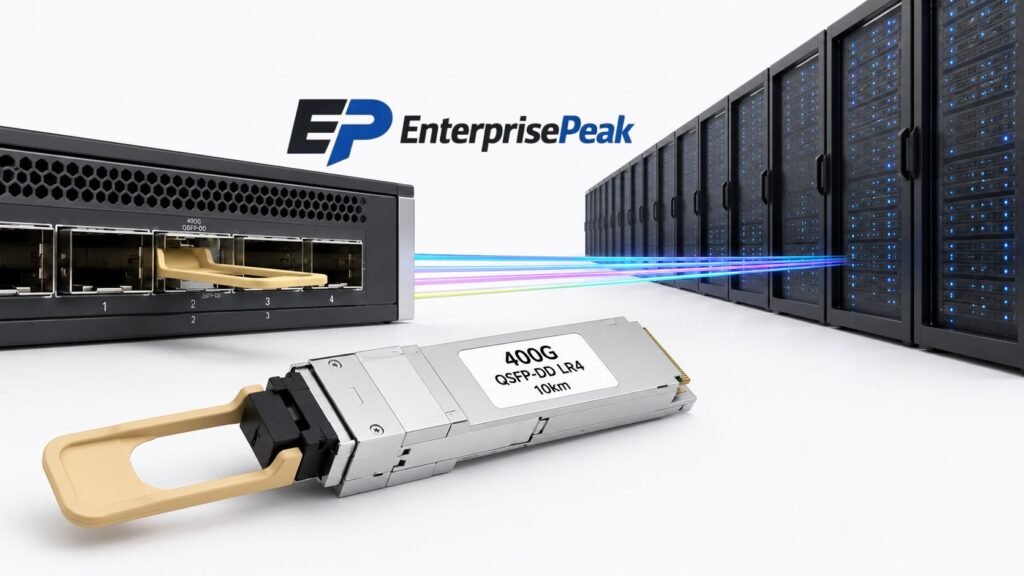

The rapid advancement of artificial intelligence (AI) is driving unprecedented demand for high-performance networking infrastructure. Large-scale AI training clusters, machine learning platforms, and data-intensive cloud applications require massive amounts of bandwidth to support communication between GPUs, storage systems, and network switches. As AI environments continue to expand beyond a single room or rack, organizations must deploy networking solutions capable of delivering both high speed and extended reach. In this context, 400G QSFP-DD modules have become a critical component for enabling scalable AI infrastructure.
Unlike traditional data center deployments that primarily focus on short-range connectivity, modern AI networks often span multiple rows, halls, buildings, or even separate data centers. These architectures require optical transceivers that can maintain reliable high-speed transmission over longer distances while preserving low latency and operational efficiency. Among the available 400G optical solutions, 400GBASE-LR4 modules offer an attractive balance between bandwidth, reach, and deployment simplicity.
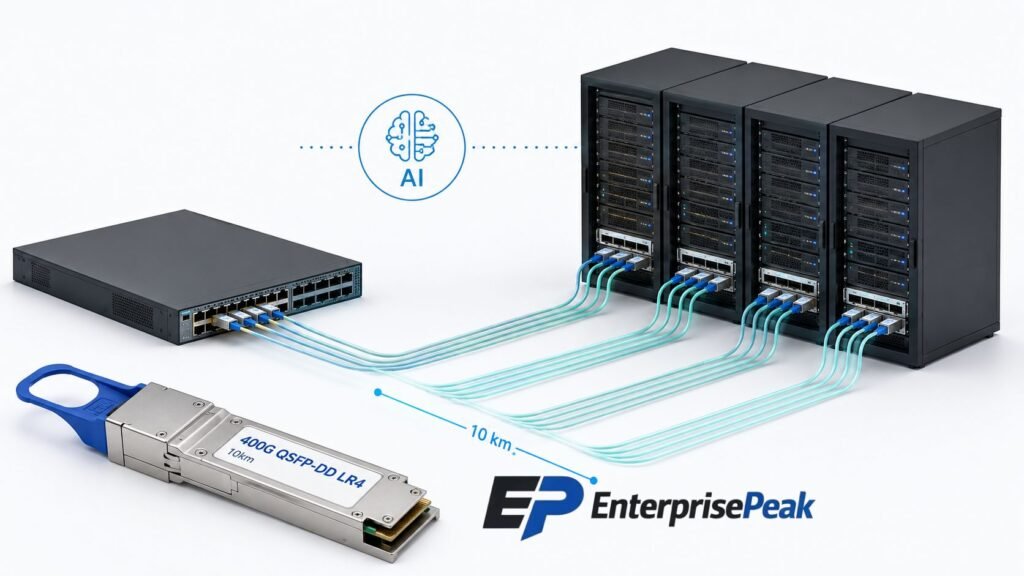
As the adoption of AI accelerates across industries, 400G QSFP-DD modules supporting the LR4 standard are increasingly being used to interconnect distributed computing resources. With transmission distances of up to 10 kilometers over duplex single-mode fiber, these transceivers provide the flexibility needed to support next-generation AI infrastructure while simplifying network design and future scalability.
Understanding 400G QSFP-DD LR4 Technology
What Is a 400GBASE-LR4 Optical Module?
A 400GBASE-LR4 optical transceiver is a high-speed Ethernet module designed to deliver 400Gbps data transmission over single-mode fiber links up to 10 kilometers. It adopts the QSFP-DD (Quad Small Form-Factor Pluggable Double Density) form factor, which provides a compact design while supporting high port density in modern switches and routers.
The LR4 designation refers to a long-reach optical interface that utilizes four optical wavelengths around the 1310nm window. Each wavelength carries approximately 100Gbps of data using PAM4 modulation technology. Through wavelength division multiplexing (WDM), these four channels are combined onto a duplex fiber pair, allowing high-capacity transmission without requiring multiple fiber connections.
Key Technologies Behind LR4
The performance of 400G LR4 modules is enabled by several advanced optical technologies. PAM4 signaling doubles the amount of data transmitted per symbol compared to traditional NRZ modulation, making it possible to achieve 400Gbps throughput while maintaining efficient use of available bandwidth. Meanwhile, wavelength multiplexing technology combines multiple optical channels onto a single pair of fibers, reducing infrastructure complexity and conserving valuable fiber resources.
In addition, Digital Optical Monitoring (DOM) capabilities provide real-time visibility into operating parameters such as temperature, voltage, transmit power, and receive power. These monitoring functions help network administrators maintain optimal link performance and quickly identify potential issues before they affect critical AI workloads.
Why Long-Reach Connectivity Matters for AI Infrastructure
Expanding AI Clusters Beyond a Single Data Hall
AI training environments are growing rapidly in both size and complexity. Modern GPU clusters may consist of thousands of accelerators distributed across multiple racks and network domains. As computational resources scale, the physical distance between servers and networking equipment often increases significantly.
Long-reach optical connectivity allows organizations to deploy AI infrastructure more flexibly without being constrained by short-distance networking limitations. With support for transmission distances up to 10 kilometers, 400G LR4 modules enable seamless communication between distributed AI resources while maintaining the high bandwidth required for large-scale model training and inference.
Supporting Multi-Building AI Deployments
Many enterprises and cloud providers operate AI facilities across multiple buildings within a campus environment. In these scenarios, short-reach optics such as SR4 or DR4 may not provide sufficient transmission distance. Deploying additional signal regeneration equipment can increase both complexity and operational costs.
By utilizing 400G LR4 optical modules, organizations can establish direct high-speed connections between buildings using existing single-mode fiber infrastructure. This simplifies network architecture while providing the performance necessary to support distributed AI computing environments.
Advantages of 400G QSFP-DD LR4 Modules for AI Networks
High Bandwidth for Data-Intensive Workloads
AI workloads generate enormous volumes of east-west traffic as GPUs exchange data during training processes. Bottlenecks in network connectivity can significantly impact overall cluster efficiency and increase model training times.
The 400Gbps bandwidth provided by LR4 modules helps ensure that data can move rapidly between compute nodes, storage systems, and network switches. This high-speed connectivity supports efficient resource utilization and contributes to faster completion of AI workloads.
Simplified Fiber Infrastructure
One of the key advantages of LR4 technology is its ability to transmit 400Gbps using only a duplex pair of single-mode fibers. Compared to parallel optics solutions that require multiple fiber pairs, LR4 significantly reduces cabling complexity.
This simplified architecture not only lowers installation costs but also improves cable management within high-density data center environments. As AI infrastructure scales, reducing fiber consumption becomes increasingly important for maintaining operational efficiency.
Extended Reach with Future Scalability
The 10-kilometer transmission capability of LR4 modules provides network designers with greater flexibility when planning infrastructure expansion. Whether connecting separate data halls, campus facilities, or regional computing centers, LR4 optics can support a wide range of deployment scenarios without requiring major architectural changes.
This flexibility helps organizations future-proof their investments as AI workloads continue to grow and networking requirements evolve toward even higher speeds.
Common Deployment Scenarios
Data Center Interconnect for AI Workloads
AI applications often require access to distributed storage systems, backup facilities, and secondary computing clusters. Data center interconnect (DCI) networks play a critical role in enabling these resources to function as a unified environment.
400G QSFP-DD LR4 modules provide the bandwidth and reach necessary to support DCI deployments while maintaining low latency and high reliability. Their ability to operate over standard duplex single-mode fiber makes them a practical solution for linking geographically separated facilities.
Cloud and Hyperscale AI Infrastructure
Cloud service providers are increasingly deploying large-scale AI platforms to support generative AI, machine learning services, and high-performance computing applications. These environments demand networking solutions that can handle continuous traffic growth while maintaining efficient power and space utilization.
The high density offered by QSFP-DD transceivers, combined with the long-distance capabilities of LR4 technology, makes them well suited for hyperscale cloud environments where performance and scalability are essential.
Future Outlook for Long-Reach AI Networking
As AI models become larger and more computationally demanding, network infrastructure will continue to play a crucial role in determining overall system performance. While 800G and future 1.6T technologies are beginning to emerge, 400G LR4 remains a highly relevant solution for many enterprise, cloud, and AI deployments.
Its combination of high bandwidth, extended reach, efficient fiber utilization, and deployment flexibility makes it an ideal choice for organizations building scalable AI infrastructure today. By leveraging 400G QSFP-DD LR4 optical modules, network operators can establish a strong foundation capable of supporting both current AI workloads and future technological advancements.
Conclusion
Building modern AI infrastructure requires more than powerful GPUs and advanced software frameworks. The network itself must deliver the bandwidth, reliability, and scalability needed to support data-intensive workloads across increasingly distributed environments.
With 400Gbps transmission speeds, duplex LC connectivity, and support for distances up to 10 kilometers, 400G QSFP-DD LR4 optical modules provide an effective solution for long-reach AI networking. Whether deployed in campus networks, cloud data centers, or large-scale AI clusters, these transceivers help organizations create high-performance infrastructure capable of meeting the growing demands of the AI era.